|
Two journalists arrested
In a letter to President Emile Lahoud, RSF
protested the arrests of journalists Antoine Bassil
and Habib Younis and
expressed its profound concern about the charges weighing against them.
"These arrests were carried out illegally. Freedom of expression is
increasingly threatened in Lebanon today. There is a clear determination on
the part of the intelligence services to muzzle the media," said Robert Ménard, the organisation's secretary-general. Moreover,
RSF recalled that on 9 August 2001, a Council of Ministers press release included
remarks that threaten media pluralism in Lebanon.
According to information collected by RSF, on 16 August, three men from the
army's intelligence services arrested Antoine Bassil,
a correspondent from the Saudi Arabian television station MBC, at his home in
Ballouné (north-east of Beirut). The Military
Tribunal is prosecuting the journalist for "contact with the enemy,
entry into enemy territory, forming an association in order to sabotage the
state's authority and damaging relations with a brother country" and
"transmission of information to the enemy." The journalist could
face the death penalty if he is found guilty.
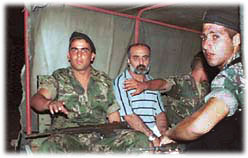 On
19 August, Habib Younis,
a senior editor at the daily Al Hayat, was arrested
at his home in Jbeil (north of Beirut) by intelligence
services agents. The director of military intelligence, Raymond Azar, informed Melhem Karam, president of the journalists' union, that Habib Younis' arrest came
"before he went to a planned Sunday meeting in Cyprus with [Odid] Zaray," an Israeli
official. Al Hayath stated that the journalist
could not have gone to Cyprus since he was scheduled to be on duty at the
newspaper's office that day. The daily added that it was informed that Habib Younis' name had been
"mentioned during interrogation of Antoine Bassil,"
who allegedly stated that he had arranged a meeting for the journalist with Odid Zaray. The two arrests
were carried out without arrest warrants and the journalists were
interrogated without lawyers present. These events have taken place in the
context of a series of raids by the army's intelligence services against
anti-Syrian Christian militias since early August. On
19 August, Habib Younis,
a senior editor at the daily Al Hayat, was arrested
at his home in Jbeil (north of Beirut) by intelligence
services agents. The director of military intelligence, Raymond Azar, informed Melhem Karam, president of the journalists' union, that Habib Younis' arrest came
"before he went to a planned Sunday meeting in Cyprus with [Odid] Zaray," an Israeli
official. Al Hayath stated that the journalist
could not have gone to Cyprus since he was scheduled to be on duty at the
newspaper's office that day. The daily added that it was informed that Habib Younis' name had been
"mentioned during interrogation of Antoine Bassil,"
who allegedly stated that he had arranged a meeting for the journalist with Odid Zaray. The two arrests
were carried out without arrest warrants and the journalists were
interrogated without lawyers present. These events have taken place in the
context of a series of raids by the army's intelligence services against
anti-Syrian Christian militias since early August.
Moreover, on 9 August, two journalists were assaulted and a third journalist
was arrested in front of the law courts in Beirut. They were covering a
demonstration against a wave of arrests of activists and sympathisers of the
Free National Current (Courant patriotique libre, CPL) and the Lebanese Forces (Forces libanaises) on 5 and 7 August in Beirut. Hussein el Moulla, an Associated Press agency photographer, was
beaten by an intelligence services agent in civilian clothes who was mingling
with the crowd of demonstrators, just as he was taking a picture of him. Sami Ayad, a photographer from
the daily "An Nahar", was photographing
demonstrators who were roughed up by intelligence services agents when
unidentified persons demanded that he hand over his film. He refused and was
beaten by them until he managed to take flight. Yehia
Houjairi, a cameraman from the official Kuwaiti
television station, was arrested by police officers as he was filming the
demonstration. The president of the photographers' union had to intervene in
order to secure his release a short time later.
That same day, following the Council of Ministers' meeting, Minister of
Information Ghazi Aridi read a statement and said
he was "responsible for putting the clauses of the media law into
effect," in order to stop the "mistakes by media outlets which
threaten state security." The previous evening, the National Audio-visual
Council (Conseil national de l'audiovisuel,
CNA) sent a document to the Council of Ministers concerning audio-visual
media outlets' coverage of 7 and 8 August events. The report specified that
the MTV television station (reputed to be close to General Aoun) "did not respect the pluralistic character of
the information..., incited the concern of viewers by provoking fear that
there would be a change in the nature of Lebanon's democratic regime...[and]
openly defied the political and security institutions, thereby threatening
public order."
|

 August
31 2001
August
31 2001